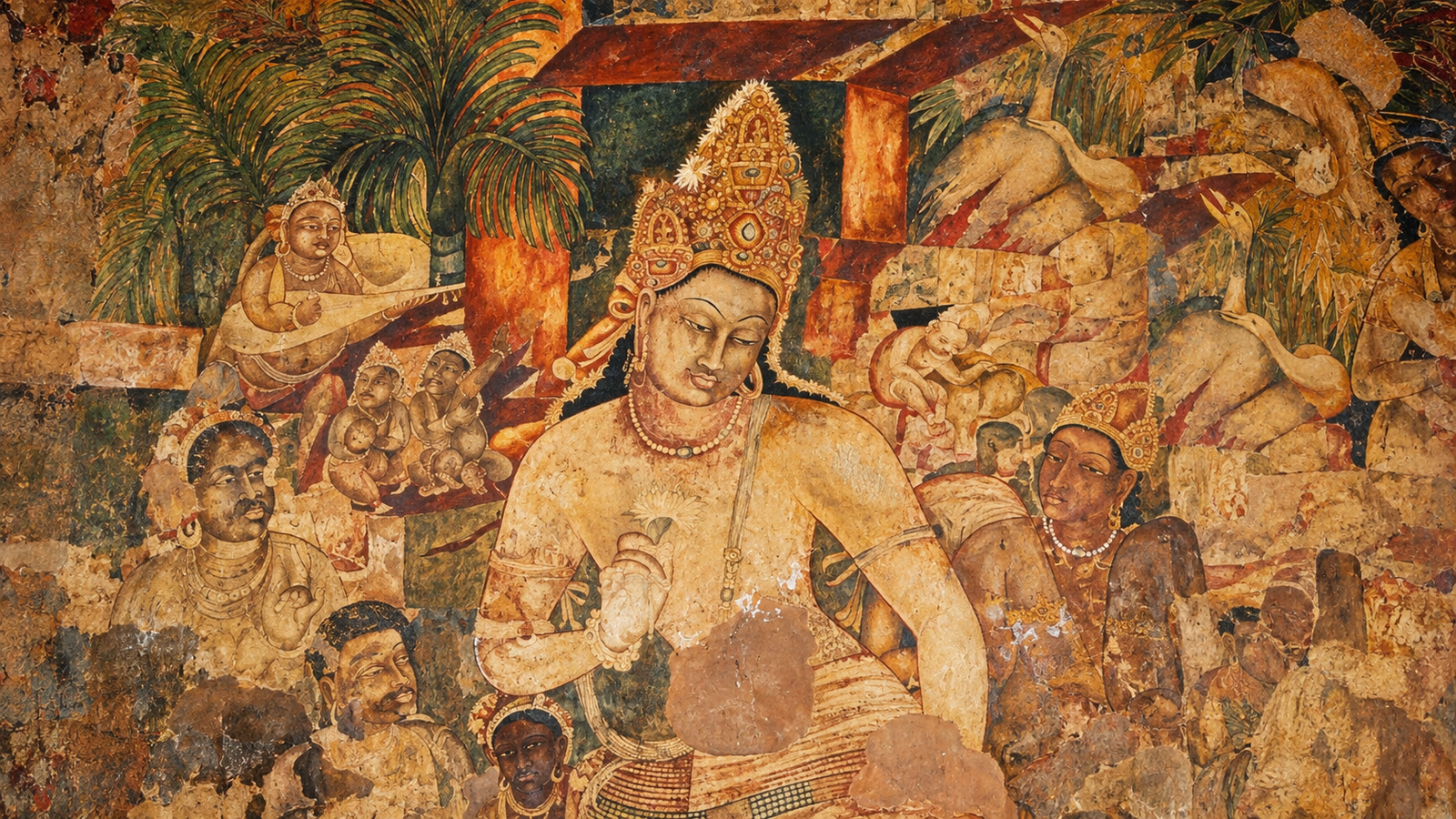
Step into Cave 1 of Ajanta in Maharashtra, and you will find one of India’s most celebrated paintings: the serene figure of a Bodhisattva holding a lotus. Commonly known as Padmapani, meaning “lotus-bearer” or “one who holds the lotus,” the figure is identified with Avalokiteshvara, one of the most important Bodhisattvas in Mahayana Buddhism*.
The Sanskrit name Avalokiteshvara is generally understood as referring to the “Lord who looks upon” or “Lord who regards” the world, reflecting his compassionate attention to beings in distress. Thus, Padmapani is the lotus-bearing form of Avalokiteshvara, while Bodhisattva is the broader term for one who follows the path toward Buddhahood for the benefit of others. The mural dates to the late 5th century CE, during the Vakataka period, when Ajanta witnessed an extraordinary flowering of Buddhist art.
The painting presents a richly adorned yet remarkably contemplative figure. Padmapani wears an elaborate jeweled crown, necklaces and other ornaments, reflecting the traditional representation of a Bodhisattva as a princely figure. His head is gently inclined, while his half-closed eyes appear to turn inward, giving his face an extraordinary sense of quiet contemplation. His elongated eyes, delicately arched eyebrows, softly modelled features and graceful posture reveal the remarkable sensitivity of Ajanta’s painters. In his hand he holds a lotus, the padma, an important Buddhist symbol associated with purity and spiritual awakening. Around him are other figures and decorative elements that form part of the larger mural composition.
But what makes Avalokiteshvara different from the Buddha?
Avalokiteshvara is a Bodhisattva, not the Buddha himself. The Sanskrit bodhisattva combines bodhi, meaning “awakening” or “enlightenment,” with sattva, meaning “being.” It is commonly understood as an “enlightened being,” one who follows the path toward Buddhahood while dedicating that journey to the liberation of others. Avalokiteshvara represents this ideal through compassion and is traditionally associated with responding to the suffering of all beings.
The Buddha, by contrast, is one who has attained complete enlightenment. The distinction, therefore, is between the fully awakened Buddha and the Bodhisattva ideal of pursuing enlightenment while remaining devoted to the liberation of others. At Ajanta, Padmapani brings these ideas together in a single sacred setting, where wisdom, enlightenment and compassion become interconnected expressions of the Buddhist path.
* Mahayana, meaning “Great Vehicle,” is one of the major traditions of Buddhism that places strong emphasis on the Bodhisattva ideal, compassion and the liberation of all sentient beings.