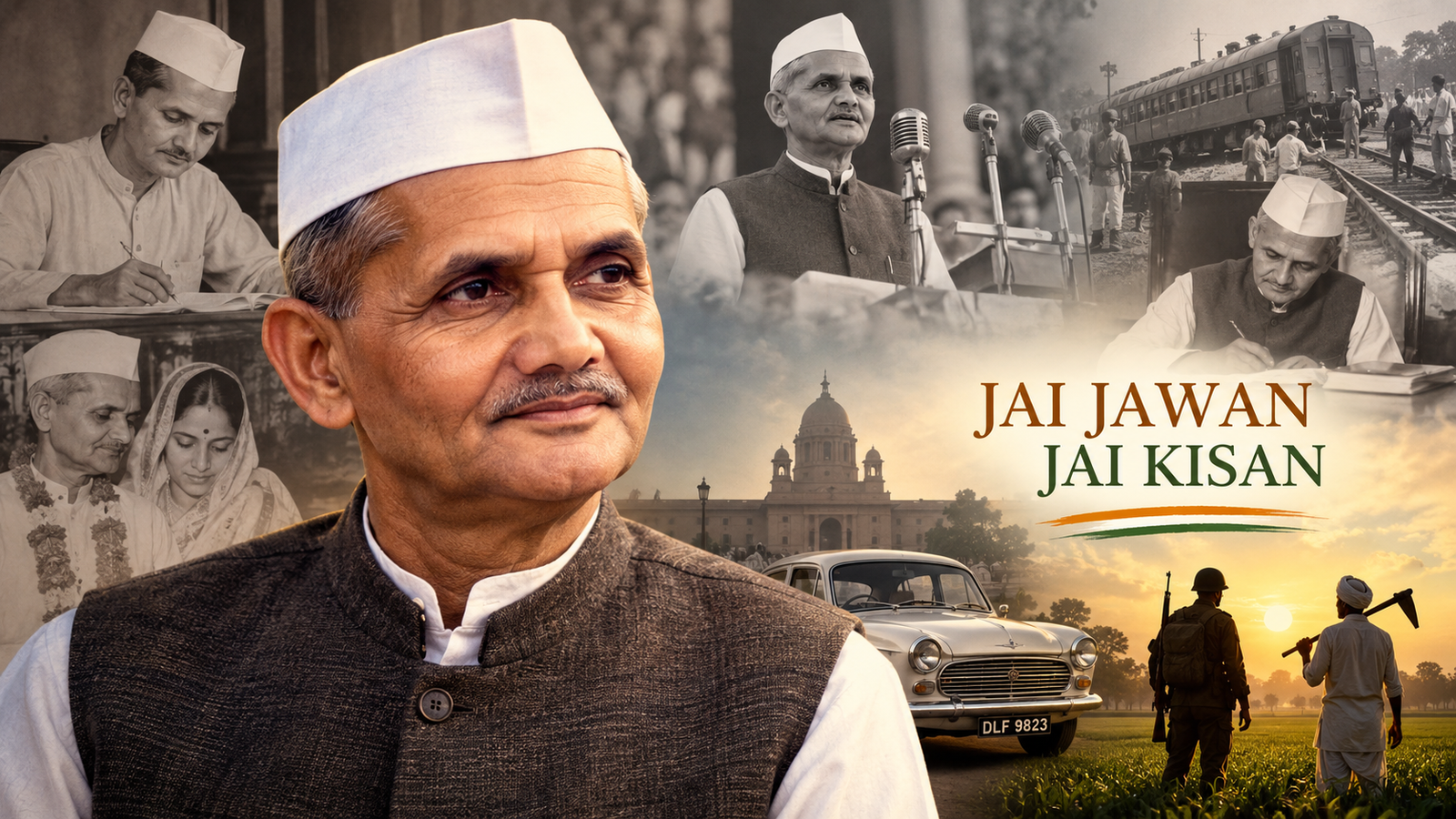
October 2 is remembered for Mahatma Gandhi’s birth anniversary. It is also the birth anniversary of another remarkable Indian whose life reflected many of Gandhi’s ideals: Lal Bahadur Shastri, born on October 2, 1904, in Mughalsarai (now Deen Dayal Upadhyaya Nagar), Uttar Pradesh.
Shastri’s simplicity was not a public relations image. It was a way of life.
When he married Lalita Devi in 1927, he refused a conventional dowry. According to the Prime Minister’s Office, he accepted a spinning wheel and a few yards of handspun cloth, reflecting the values of self-reliance and swadeshi.
Years later, as Prime Minister, he did not want government resources used for his family’s personal needs. Instead, his family purchased a Fiat costing about ₹12,000. Shastri had around ₹7,000 in savings and borrowed the remaining ₹5,000 from Punjab National Bank. When he died in 1966, the loan remained unpaid. His wife, Lalita Shastri, later repaid it from her pension.
His sense of accountability was equally striking. As Railway Minister, he offered his resignation after the deadly railway accidents of 1956. After the Ariyalur accident, which claimed more than 140 lives, Prime Minister Jawaharlal Nehru accepted his resignation, while making clear that Shastri was not personally responsible. Nehru said he accepted it to uphold constitutional propriety and set an example of ministerial accountability.
Before becoming Prime Minister, Shastri served as Parliamentary Secretary and Home Minister in Uttar Pradesh. At the Centre, he held portfolios including Railways, Transport and Communications, Commerce and Industry, and Home Affairs. He became India’s second Prime Minister in 1964.
During the food shortages of the mid-1960s, Shastri appealed to citizens to voluntarily skip a meal to conserve grain. During the 1965 war, he gave India the enduring call, “Jai Jawan, Jai Kisan,” linking national security with the nation’s farmers and food security.
Even 14 kilometres of personal travel by his sons in the Prime Minister’s official car did not escape his scrutiny. According to an account by his son Sunil Shastri, he checked the logbook and instructed that the corresponding amount be deposited into the government account. Another family account says he also had an undue promotion given to his son reversed.
On January 10, 1966, Shastri signed the Tashkent Declaration with Pakistan’s President Ayub Khan. The following day, in Tashkent, he died suddenly. The official cause was a myocardial infarction, although questions about the circumstances of his death have persisted.
He was awarded the Bharat Ratna posthumously in 1966, becoming the first recipient to receive India’s highest civilian honor after death.
Shastri left behind no grand fortune built through public office. What he left was something harder to acquire: a reputation for personal austerity, accountability and integrity.