
Summer is the time when many consider purchasing ACs. We often hear terms like 1 ton, 1.5 ton, and inverter ACs without fully understanding what they mean. Here’s what you actually need to know.
Why was AC invented?
Interestingly, the air conditioner wasn’t originally designed for human comfort. In 1902, Willis Havilland Carrier, a young engineer in Buffalo, New York, was hired to solve a crisis at a Brooklyn printing company. During summers, humidity caused paper to absorb moisture, expand, and misalign with ink plates—ruining prints. Carrier designed a system that circulated air over coils chilled by compressed ammonia, controlling both temperature and humidity. This ensured precise printing. The first modern air conditioner was built to save paper, not people.

Willis Havilland Carrier – The Inventor of Modern Air Conditioning
How does an AC work
An air conditioner functions as a heat transporter rather than a “cold air” creator. Using a specialized chemical called refrigerant, the unit absorbs heat from indoor air through evaporator coils, causing the liquid refrigerant to turn into a gas. This hot gas is then pumped to the compressor and sent to the outdoor condenser coils, where the heat is released into the outside environment. As the refrigerant cools and reverts to a liquid state, it cycles back indoors to repeat the process, continuously lowering the room’s temperature and humidity levels.
What do 1 ton and 1.5 ton mean?
When you shop for an AC, the terminology can be confusing. For example, a 1-ton AC does not weigh 1,000 kg. “Tonnage” refers to cooling capacity. The amount of heat required to melt one ton of ice (about 907 kg) in 24 hours. A 1.5-ton AC can remove 1.5 times that heat, making it suitable for larger rooms.
The “ice” connection dates back to a time before modern air conditioning, when cooling was achieved using large blocks of natural ice. In the 19th and early 20th centuries, ice was stored and even used with fans to cool rooms by blowing air over it. The term “1 ton” of cooling comes from this practice—it is the amount of heat required to melt one ton of ice in 24 hours. Before ACs, buildings stayed cool through thick walls, high ceilings, and cross-ventilation, with ice-based cooling used in some cases. Modern ACs replicate this same heat-removal process far more efficiently—without using ice.
Choosing the right tonnage depends on room size, insulation, and climate. As a rule of thumb:
- 1-ton AC → suitable for small rooms (~100–120 sq. ft.)
- 1.5-ton AC → medium rooms (~120–180 sq. ft.)
- 2-ton AC → larger rooms (~180–250 sq. ft.)
Actual requirements can vary based on factors like ceiling height, insulation, number of occupants, and local climate.
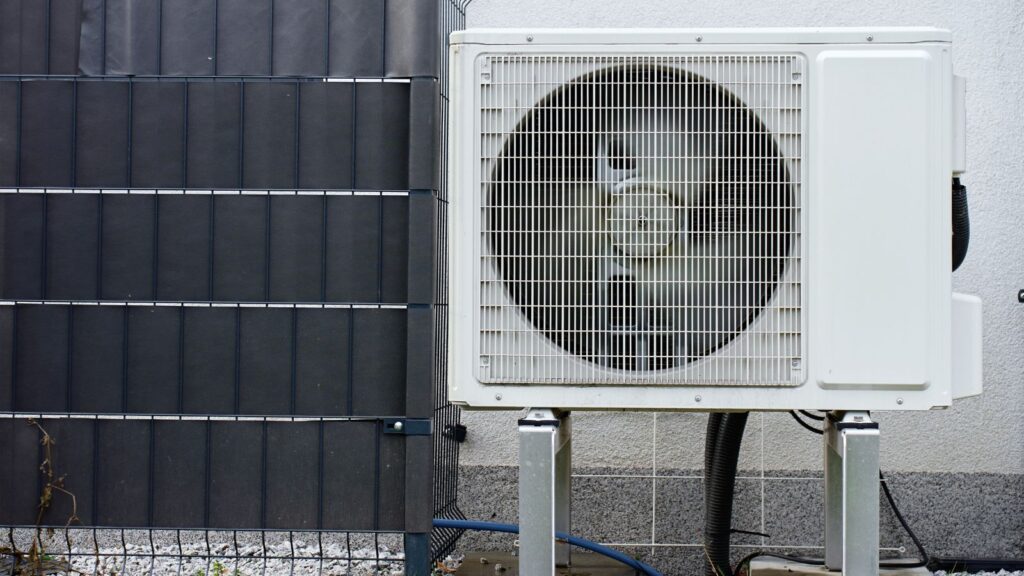
The Compressor Unit of an Air Conditioner
The BTU connection
BTU (British Thermal Unit) measures heat energy. One BTU is the amount of heat required to raise the temperature of 1 pound of water by 1°F (about 0.56°C).
In ACs, BTUs indicate how much heat the unit can remove per hour. A 1-ton AC equals about 12,000 BTU/hour. Higher BTU means greater cooling capacity. Choosing the right level is crucial—too low won’t cool effectively, while too high can waste energy and cause uneven cooling.
Star ratings explained
Star ratings indicate energy efficiency. In India, the Bureau of Energy Efficiency (BEE) rates ACs from 1 to 5 stars. A 5-star unit consumes significantly less electricity than a 3-star model for the same cooling output. Over a year of regular use, the electricity savings from a higher-rated model typically offset its higher purchase price.
Inverter vs. conventional.
A conventional AC runs at a fixed speed. It turns fully on when the room is warm and fully off once it cools. An inverter AC, on the other hand, acts like an accelerator in a car. It uses a variable-speed compressor that adjusts continuously to match the room’s cooling demand. This reduces energy consumption, maintains a more stable temperature, operates more quietly, and extends compressor life. For regular use, an inverter AC is typically the better long-term choice.
With the right knowledge, buying an AC shifts from guesswork to a smart, well-informed decision. The best AC isn’t the most powerful; it’s the one that’s right for your space, usage, and efficiency needs.