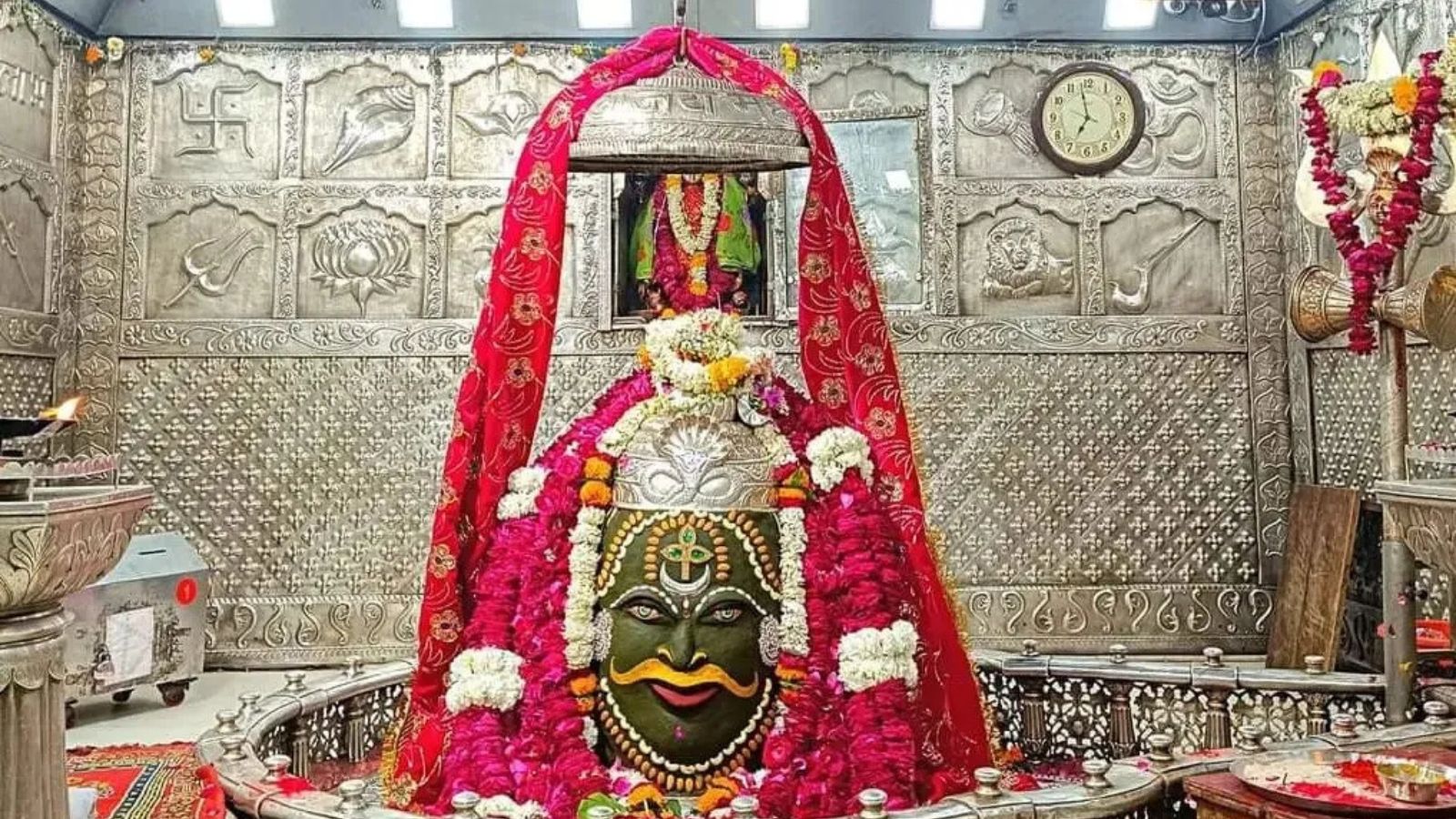
Ujjain’s Mahakaleshwar Temple, located on the banks of the sacred Shipra River in Madhya Pradesh, is among the twelve Jyotirlingas. A Jyotirlinga is believed to be a manifestation of Shiva in the form of a radiant pillar of light, symbolizing his infinite and formless nature. Devotees consider visiting all twelve Jyotirlingas a sacred pilgrimage that leads to spiritual liberation.
Unlike most other Jyotirlingas, Mahakaleshwar is said to be Swayambhu, “self-manifested,” emerging from its own divine power rather than being established by human effort. The presiding deity faces south, a rare orientation associated with the form of Shiva as Mahakal, the Lord of Time and Death, who transcends the boundaries of life and the cosmic order.
The temple’s ritual centerpiece is the Bhasma Aarti, performed at dawn, where the lingam is anointed with sacred ash, symbolizing the impermanence of life. The ceremony draws thousands of devotees daily and reflects a deep spiritual philosophy that celebrates both creation and dissolution. Ujjain itself has long been a center of learning and astronomy, referenced in ancient texts such as the Puranas and associated with figures like King Vikramaditya and the scholar Varahamihira.
A persistent belief surrounding Ujjain holds that those who stay overnight, particularly rulers and political leaders, risk misfortune. Arising from astrological and mythological traditions, it is said that Mahakal governs not only mortality but also the fate of kings. Leaders often avoid spending the night in deference to this belief, viewing it as a gesture of respect toward the city’s potent spiritual energy and its presiding deity’s dominion over worldly power.