Recently, I was flipping through AI Agents in Action by Michael Lanham. Inside the book, there’s an interesting detail about the cover page, which is often overlooked.
At first glance, it seems like an unusual choice for a book about cutting-edge artificial intelligence. Instead of robots, futuristic interfaces, or abstract digital imagery, the cover features a nineteenth-century figure dressed in traditional European attire. Curious, I dug deeper.
The illustration depicts “Clémentinien,” one of the hand-colored lithographs from Illustrations de L’Illyrie et la Dalmatie, published in 1815 by Balthasar Hacquet. Hacquet was a physician, naturalist, and ethnographer who spent years documenting the people, customs, occupations, and clothing of the Adriatic regions of Illyria and Dalmatia. His work emerged during the late Enlightenment, a period when scientific observation expanded beyond astronomy and medicine to include the systematic study of human societies.
What makes Hacquet’s illustrations so fascinating is that they were far more than portraits. They captured and preserved the identities, traditions, and ways of life of the people he encountered. In an age before business cards, résumés, websites, or LinkedIn profiles, a person’s clothing, tools, and appearance often communicated their profession, social role, and place within the community. A merchant looked different from a shepherd. An artisan dressed differently from a soldier. Their specialization was visible.
This is where the cover’s symbolism becomes remarkably relevant to the subject of AI.
Manning Publications has long used historical illustrations on its book covers. These figures represent people with distinct skills, trades, and responsibilities. Seen through that lens, Clémentinien transcends his role as a historical character and becomes a metaphor.
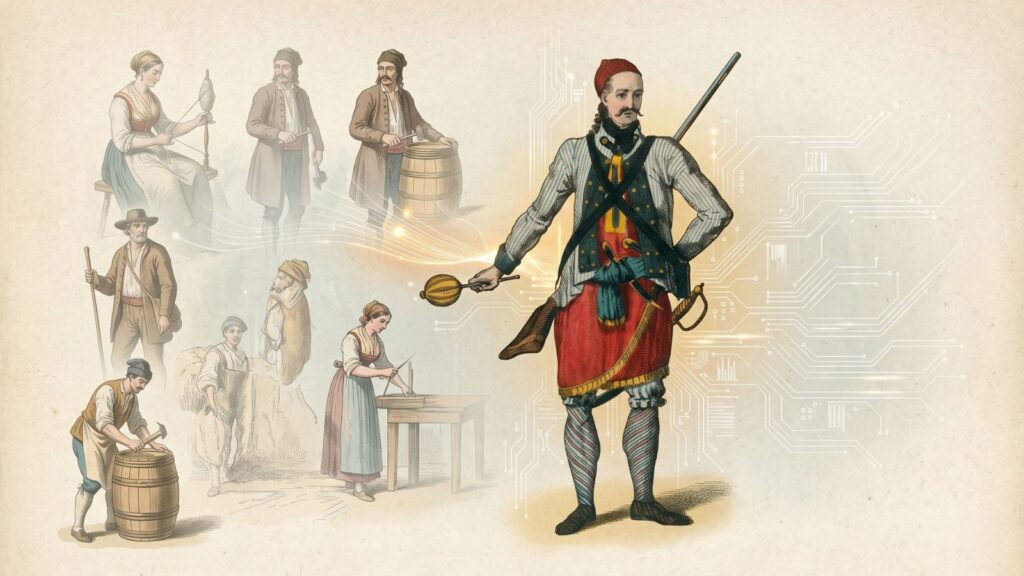
Two hundred years ago, society depended on specialized human agents. Each individual had a defined function, expertise, and set of responsibilities within a larger economic system.
Today, we are building a similar ecosystem in the digital world.
AI agents are designed with specific roles. One gathers information, another analyzes data, another automates workflows, and yet another assists with decision-making. Like the craftsmen, traders, and professionals of Hacquet’s era, modern AI agents derive their value from performing particular tasks exceptionally well and collaborating within a broader network.
The parallel is relevant. While the tools have evolved, from the craftsman’s toolkit and the accountant’s ledger to algorithms and large language models, the underlying principle remains the same: progress is driven by specialization.
What initially appears to be an old-fashioned image on a modern AI book turns out to be a thoughtful reminder that technology often echoes patterns that have existed throughout human history. Every era creates its own agents, whether individuals or systems, entrusted with specific responsibilities that contribute to something larger than themselves.
The cover of the book conveys that innovation is not restricted to technology. It extends humanity’s long tradition of specialization, collaboration, and ingenuity, connecting the artisans of 1815 with the autonomous AI agents of the twenty-first century.
Two centuries from now, what symbols will people use to represent the specialized agents of our era?