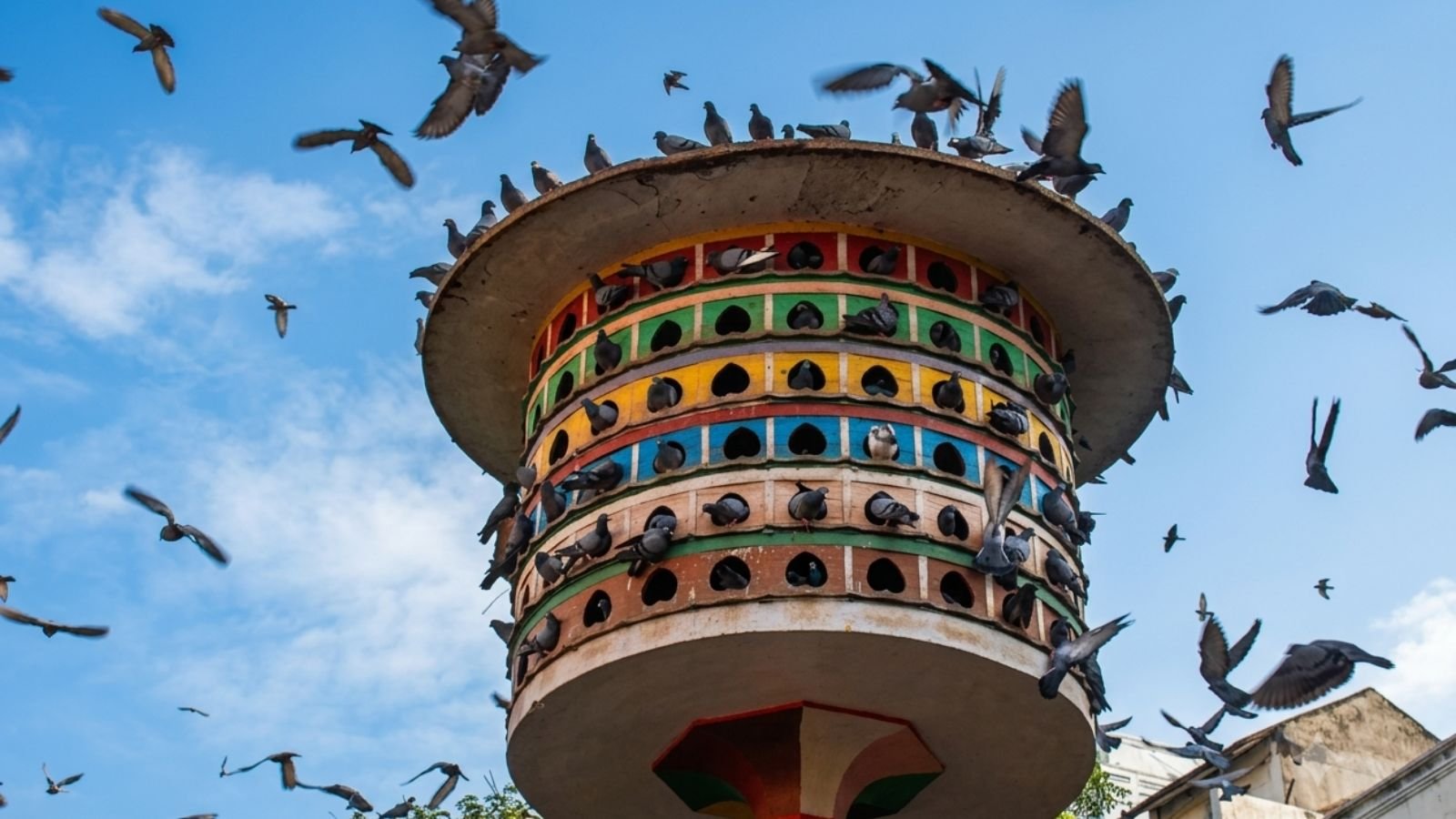
Walk through the older parts of Hyderabad, and you may hear the flutter of wings before you notice the pigeons. They gather around mosques, dargahs, parks, bridges and old neighborhoods, sometimes in astonishing numbers. Dedicated kabutar khanas, or pigeon houses, have existed for generations in places such as Hussain Alam and Sultan Bazaar. People come to scatter grains, while vendors selling bird feed have built a small livelihood around the tradition. The nearly 200-year-old Hussain Alam pigeon house is reported to shelter more than a thousand pigeons.
From messengers to mughal pastime
The relationship between humans and pigeons goes far beyond feeding them. Their remarkable homing ability made them useful as messengers, while their speed and flying skills also made them popular as racing and performing birds. They were even raised as food. Among the Mughals, however, pigeon-keeping became an elaborate courtly pastime. The fascination had roots among Central Asian and Indian elites, but the Mughal emperors took it to another level. Babur’s father, Umar Sheikh Mirza, ruler of Ferghana, met an unusual fate in 1494 when the pigeon house he was visiting collapsed, killing him. Babur recorded the incident in his memoirs.
Akbar, Shah Jahan and the pigeon craze
Akbar was fascinated by pigeons. Abu’l-Fazl’s Ain-i-Akbari describes their breeding, training and flying abilities, with historical accounts indicating that the emperor maintained a remarkably large collection. The passion continued among Mughal elites in Delhi, especially after Shah Jahan established Shahjahanabad. By the time of Bahadur Shah Zafar, pigeon flying had become deeply embedded in Delhi’s culture. Later accounts even describe trained pigeons flying above the emperor’s elephant during processions, creating what was remembered as a canopy over his head. This colorful detail, however, is better regarded as a historical tradition than as a firmly documented routine practice.
Odisha’s pigeon post that survived technology
Pigeons also played a surprisingly modern role in India. The Odisha Police established a pigeon communication service in 1946, using Belgian Homer pigeons to carry messages to places where telephone and wireless communication was unavailable or unreliable. The birds were used during emergencies, including floods and cyclones. Although routine pigeon messaging was discontinued in 2008 as modern communications rendered it unnecessary, Odisha Police continues to maintain pigeon lofts at Cuttack and Angul. The birds are now preserved largely as a living piece of communications history, demonstrating how an ancient method of sending messages survived well into the age of telephones, wireless sets and digital communication.
From Mughal palaces to Hyderabad’s kabutar khanas and Odisha’s police lofts, the pigeon has lived many lives. What appears to be an ordinary bird, and even a nuisance today, once played extraordinary roles in India’s social, cultural and communication history.