
Gold prices may swing wildly, but what often remains misunderstood is the metal itself. When someone says “22K” or “916,” they’re talking about purity of the metal, not its weight.
The Purity Scale
Gold purity is measured on a 24-part scale known as Karats* (K). 24K gold is 99.9% pure—the “gold standard” for bullion and coins. However, you will rarely find 24K jewelry because pure gold is incredibly soft and malleable, losing shape easily. This makes it unsuitable for everyday jewelry. That’s why pure gold (24K) is available in coin or bar form.
To make gold “wearable,” it is alloyed with harder metals such as copper, silver, zinc, or nickel.
- 22K Gold (91.6% purity): Also known as “916,” it contains 22 parts gold and 2 parts alloy (usually copper and silver). It strikes a balance for traditional, intricate jewelry. In percentage terms, 22K gold contains 91.6% gold (22/24 × 100).
- 18K Gold (75% purity): Contains 18 parts gold and 6 parts alloy. This is preferred for diamond-studded jewelry, as the higher alloy content makes it strong enough to securely hold stones.
The “Hall” in Hallmark
Hallmarking is the official certification of the purity of precious metals (such as gold, silver, platinum, or palladium) by stamping them with a mark that guarantees their composition. When you see a hallmark on a piece of jewelry, it indicates a trusted assurance that the metal meets a defined standard (for example, 22K gold).

Goldsmiths Hall in London where hallmarking originated
Hallmarking dates back over 700 years to medieval Europe. In 1327, King Edward III of England granted a charter to the “Worshipful Company of Goldsmiths.” They were headquartered at Goldsmiths’ Hall in London. Any gold item sold had to be brought to the Hall to be tested (assayed) and marked with an official stamp. This was one of the world’s earliest forms of consumer protection.
Goldsmith guilds played a crucial role in maintaining standards, and over time, hallmarking systems spread across Europe and later the world. In India, a hallmark is issued by the Bureau of Indian Standards (BIS).
How to Read the Symbols
A hallmark is a “passport” for your ornament. When you look through a jeweler’s loupe, you should see:
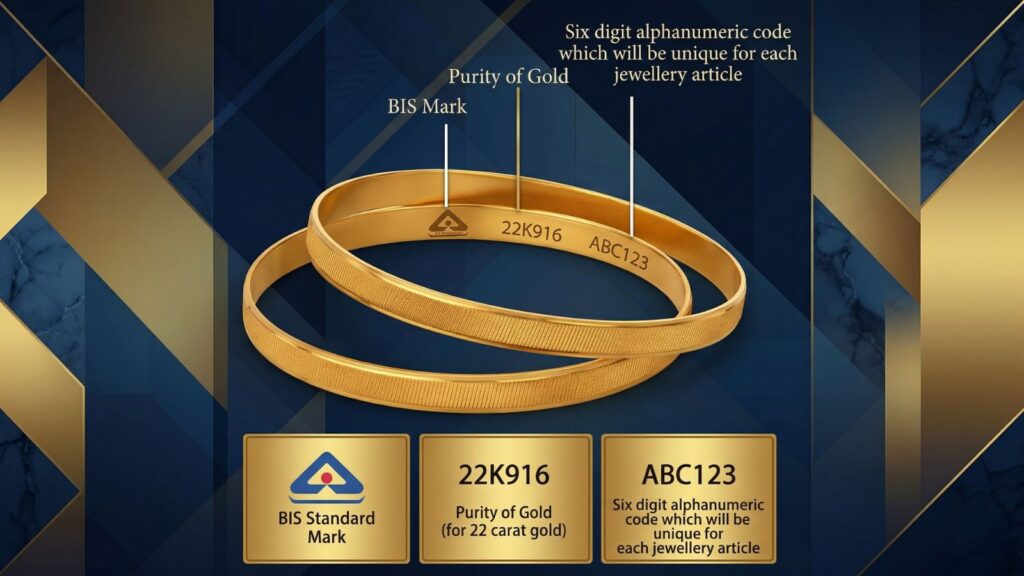
- Standard logo: For example, BIS triangle in India
- Purity mark: 916 (22K), 750 (18K), or 585 (14K)
- Assaying center mark: A logo identifying the lab that tested the piece
- HUID**: A unique alphanumeric code for digital traceability
Next time you step into a jewelry store, look for these stamps. They are the only thing standing between an investment and an expensive mistake.
* Etymology Note: The term Karat (k) traces its origin to carob seeds, from the Ceratonia siliqua tree. In ancient times, traders across the Mediterranean noticed that these seeds were remarkably uniform in weight. Because of this consistency, they were used as natural counterweights on balance scales for measuring gold and gemstones. While Karat (K) measures gold purity, Carat (ct) measures gemstone weight. Both terms have the same root.
** HUID (Hallmark Unique Identification) is a six-digit alphanumeric code (e.g., AZ1234) laser-etched on every gold jewelry piece alongside hallmark symbols. Think of it as a digital fingerprint for your gold. Each piece has a unique code, with no duplicates. Registered on the Bureau of Indian Standards (BIS) portal, it captures key details: the jeweler, the assay center, and the date of certification. HUID helps eliminate hallmarking fraud by ensuring every stamped piece is traceable and genuine.