More than 220 years before ChatGPT, a machine was already doing something that feels surprisingly familiar: following instructions encoded by humans and turning them into something new.
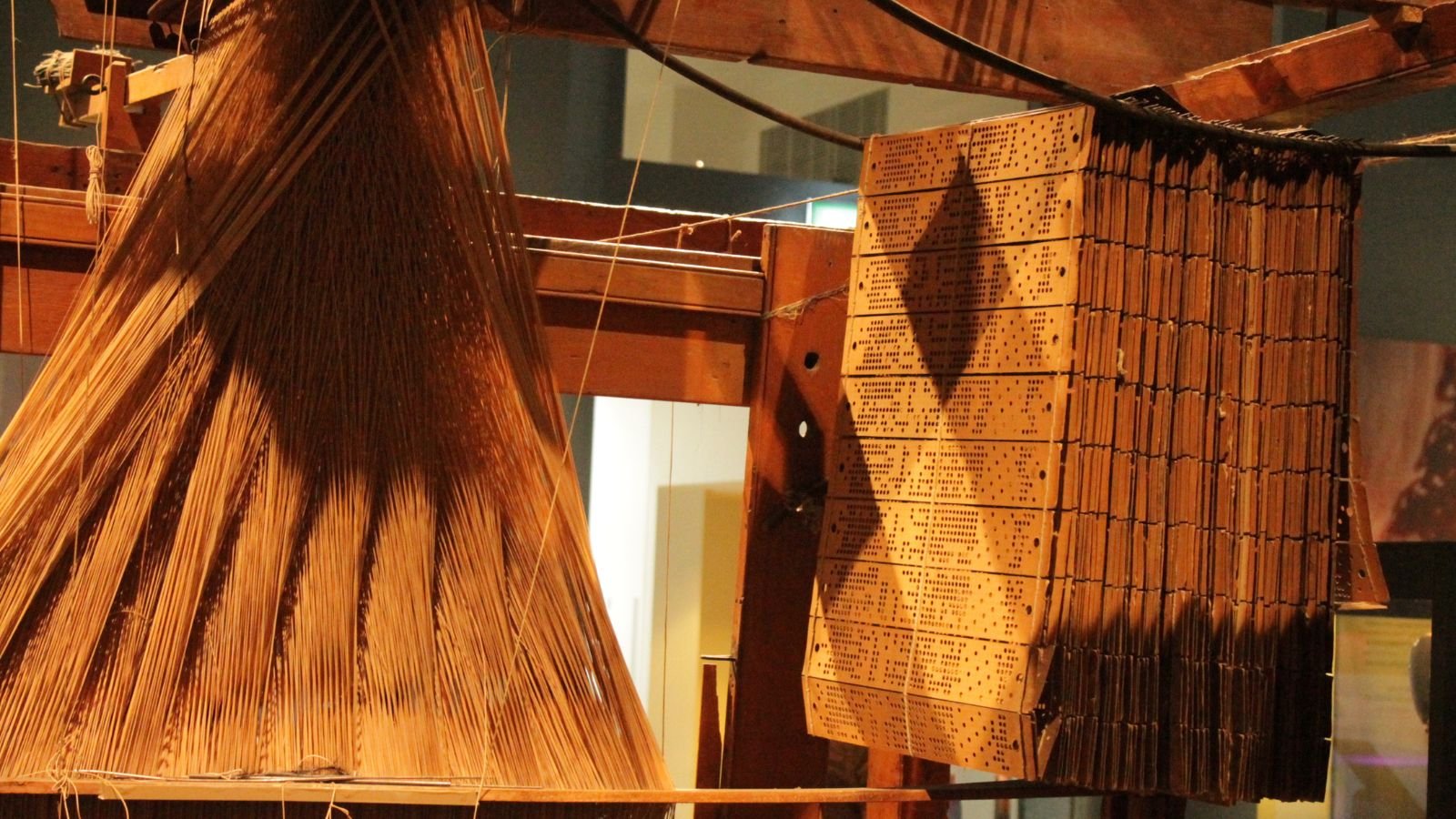
In 1801, French inventor Joseph-Marie Jacquard demonstrated a loom controlled by a series of punched cards. The holes on each card determined which threads the loom would raise, allowing it to produce intricate textile patterns automatically. A complex design could be encoded into a sequence of cards and reproduced again and again.
The pathbreaking idea was not only about automation. It separated instructions from the machine that executed them.
A designer could create the pattern. The pattern could then be encoded into cards. The loom would follow those instructions without requiring a master weaver to control every individual movement.
That sounds surprisingly close to the relationship between us and ChatGPT.
We provide instructions, or prompt. The model processes it and produces the result. Change the instruction, and the output changes. The system does not need us to specify every step in the way a traditional tool would. We describe what we want, and the system handles much of the execution.
The Jacquard loom also became an important steppingstone in the history of computing. Charles Babbage borrowed the punched-card idea for his proposed Analytical Engine, a general-purpose programmable machine. In 1843, Ada Lovelace wrote in her notes on the engine: “We may say most aptly, that the Analytical Engine weaves algebraical patterns just as the Jacquard-loom weaves flowers and leaves.”
That connection offers a useful way to think about today’s AI.
ChatGPT may look radically different from a 200-year-old loom. But the underlying idea is surprisingly familiar: encode human intent into instructions, give those instructions to a machine, and let the machine do the work.
The technology changed.
The idea didn’t.