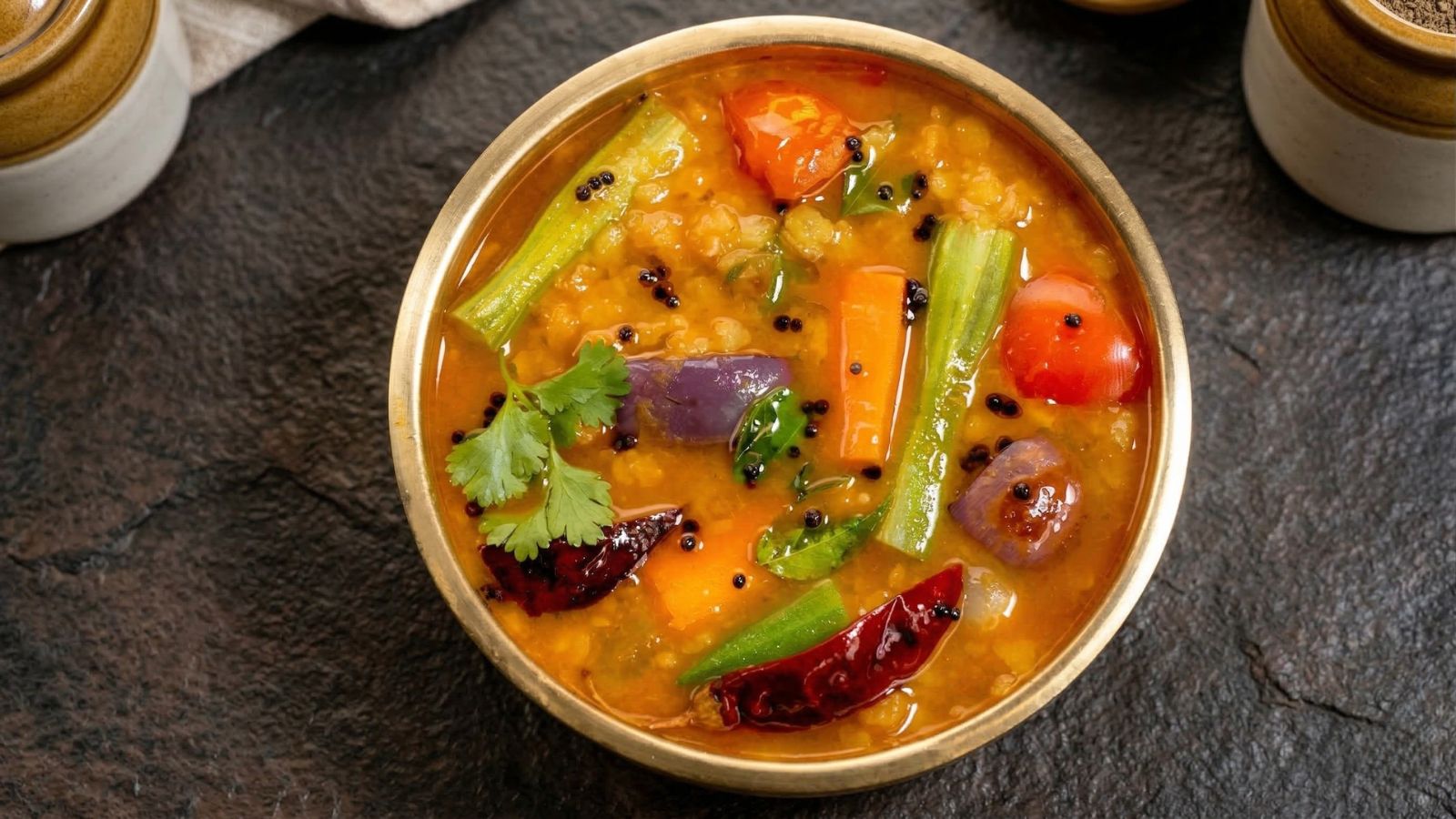
Few South Indian dishes are as beloved as sambar. This tangy stew of lentils and vegetables, the familiar partner to idli, dosa, and rice, is so deeply woven into everyday meals that it seems ancient. Yet its story may lead to a surprisingly precise setting: the royal kitchens of Thanjavur in the late seventeenth century, during the period of Maratha rule.
A Kitchen Without Kokum
The most widely documented account places the birth of sambar in the Thanjavur Maratha kingdom during the reign of Shahuji I (1684–1712). The Marathas had taken control of Thanjavur a decade earlier, bringing with them the culinary traditions of Maharashtra. Among these was amti, a mild, sour lentil dish traditionally flavored with kokum—a dried fruit native to the Western Ghats.
Legend has it that Shahuji, a patron of the arts who occasionally dabbled in the kitchen, once set out to prepare amti only to find the royal pantry had run out of kokum. In a moment of improvisation, either the King or his chefs substituted the local tamarind as the souring agent.
The experiment was a triumph. The resulting blend of pigeon pea lentils (toor dal), local vegetables, spices, and tamarind was served to Shahuji’s cousin, Sambhaji (the son of Chhatrapati Shivaji), who was visiting Thanjavur at the time. To honor his guest, the dish was named “sambar,” and a culinary icon was born.
The Politics of the Plate
While the story is charming, historians suggest the reality may have been more calculated. In The Bloomsbury Handbook of Indian Cuisine (2023), food historian Sourish Bhattacharyya notes that the relationship between the families of Shahuji I and Sambhaji was historically strained. This friction casts some doubt on the “accidental” nature of the dish. It is possible that Shahuji deliberately named the dish after Sambhaji as a diplomatic gesture, offering a “culinary olive branch” to foster cordial relations between the two Maratha families.
Was Sambar Already There?
Evidence suggests that dishes resembling sambar existed before the Marathas arrived in Thanjavur.
A verse in Amuktamalyada, a Telugu epic written around 1517 by the Vijayanagara emperor Krishnadevaraya, mentions the term “sambarampuchintapandu.” Scholars interpret this phrase as referring to ingredients used to prepare a tamarind-based stew similar to sambar.
This suggests that a lentil-and-tamarind preparation was already known in South India at least a century before the Maratha story.
Further evidence comes from a 1648 Kannada text, Kanthirava Narasaraja Vijaya, which refers to a sour vegetable-and-lentil dish called huli, another possible precursor to modern sambar.
A Culinary Synthesis
These accounts need not contradict each other. The Maratha kitchen likely refined this local dish, standardizing the use of toor dal and specific spices, and then rebranded it with a royal name that stuck.
Another historical layer involves the chilli pepper, which reached India from the Americas via Portuguese trade in the 16th century and spread widely only in the following centuries. The spicy sambar familiar today therefore represents a later evolution of the dish.
A Dish with Many Histories
Like many iconic foods, sambar likely emerged from culinary exchange rather than a single invention. Local South Indian cooking traditions, Maratha court influences, and newly introduced ingredients gradually combined to produce the dish now regarded as a cornerstone of South Indian cuisine.