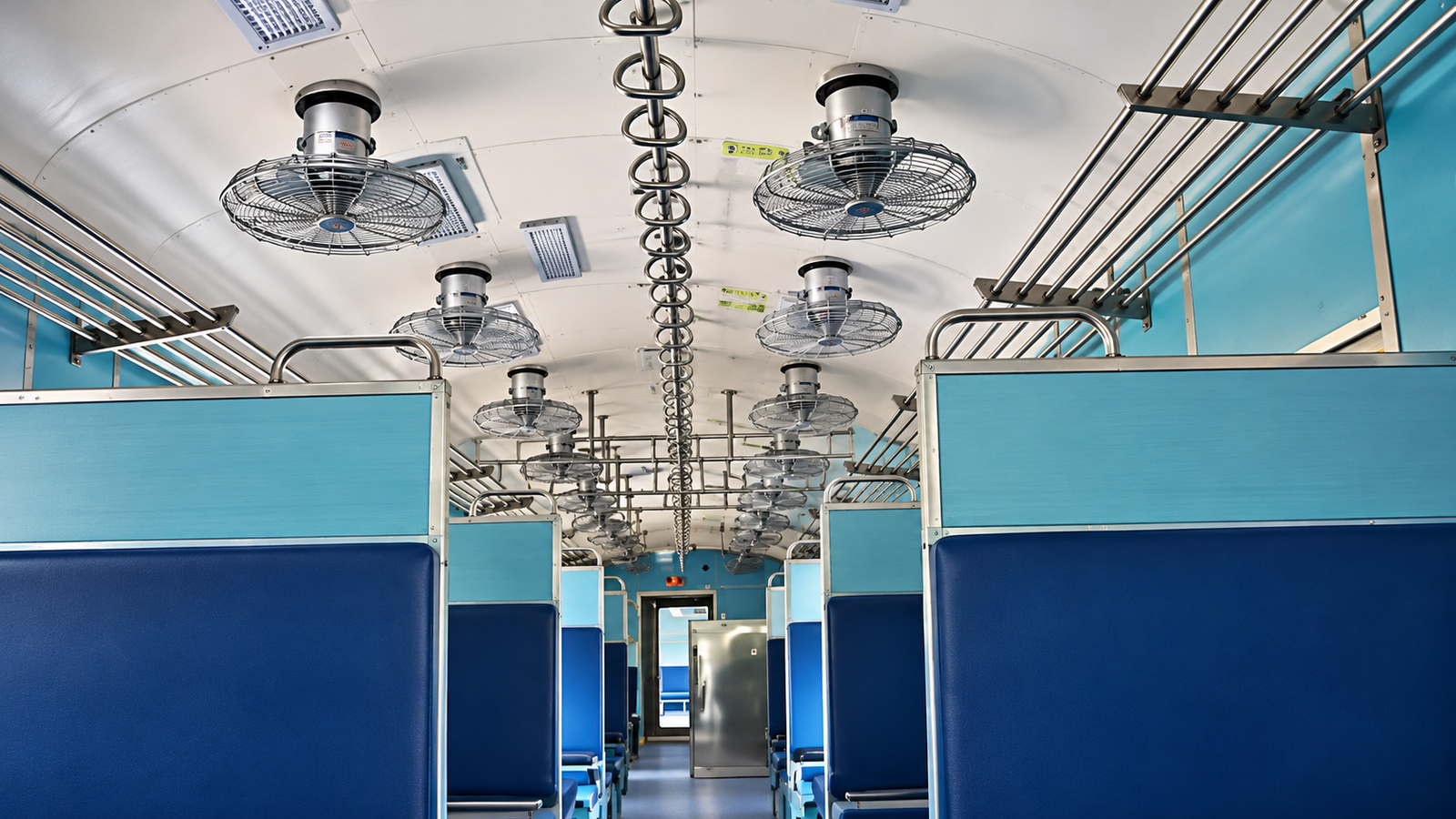
Stealing a ceiling fan from an Indian Railways coach is hardly worth the effort, thanks to a clever anti-theft measure built into its design. Indian Railways has adopted an ingenious approach to discourage fan theft: the fans installed in non-air-conditioned coaches are designed to operate on 110-volt Direct Current (DC), unlike the conventional household electricity supply.
Electricity supplied to Indian homes is generally 230-volt Alternating Current (AC). Most domestic ceiling fans are designed to work on this supply. Railway carriage fans, however, are specifically engineered for a 110V DC system. This means you cannot simply remove one from a train, take it home and plug it into a regular electrical socket. You would need suitable power-conversion equipment and electrical modifications to make it work.
There is more to this arrangement than preventing theft. Non-AC railway coaches use an electrical system in which an axle-driven alternator generates electricity as the train moves. This electricity is regulated and stored in batteries, supplying power to lights, fans and other onboard equipment. The 110V DC fans are designed to work with this arrangement.
Interestingly, while the 110V DC specification is documented in Indian Railways’ technical standards, its adoption specifically as an anti-theft measure is widely reported rather than explicitly established as the original engineering rationale. Nevertheless, it offers a practical deterrent. Instead of relying entirely on surveillance and security, Indian Railways has made its equipment less useful outside the railway ecosystem.
Sometimes, the smartest way to prevent theft is to make the stolen object less valuable to the thief!
AC (alternating current) is electricity that keeps reversing direction, which makes it ideal for delivering power through wall outlets and long-distance grids. DC (direct current) flows steadily in one direction, making it ideal for batteries and electronic devices. In short, AC powers homes, while DC powers batteries and gadgets