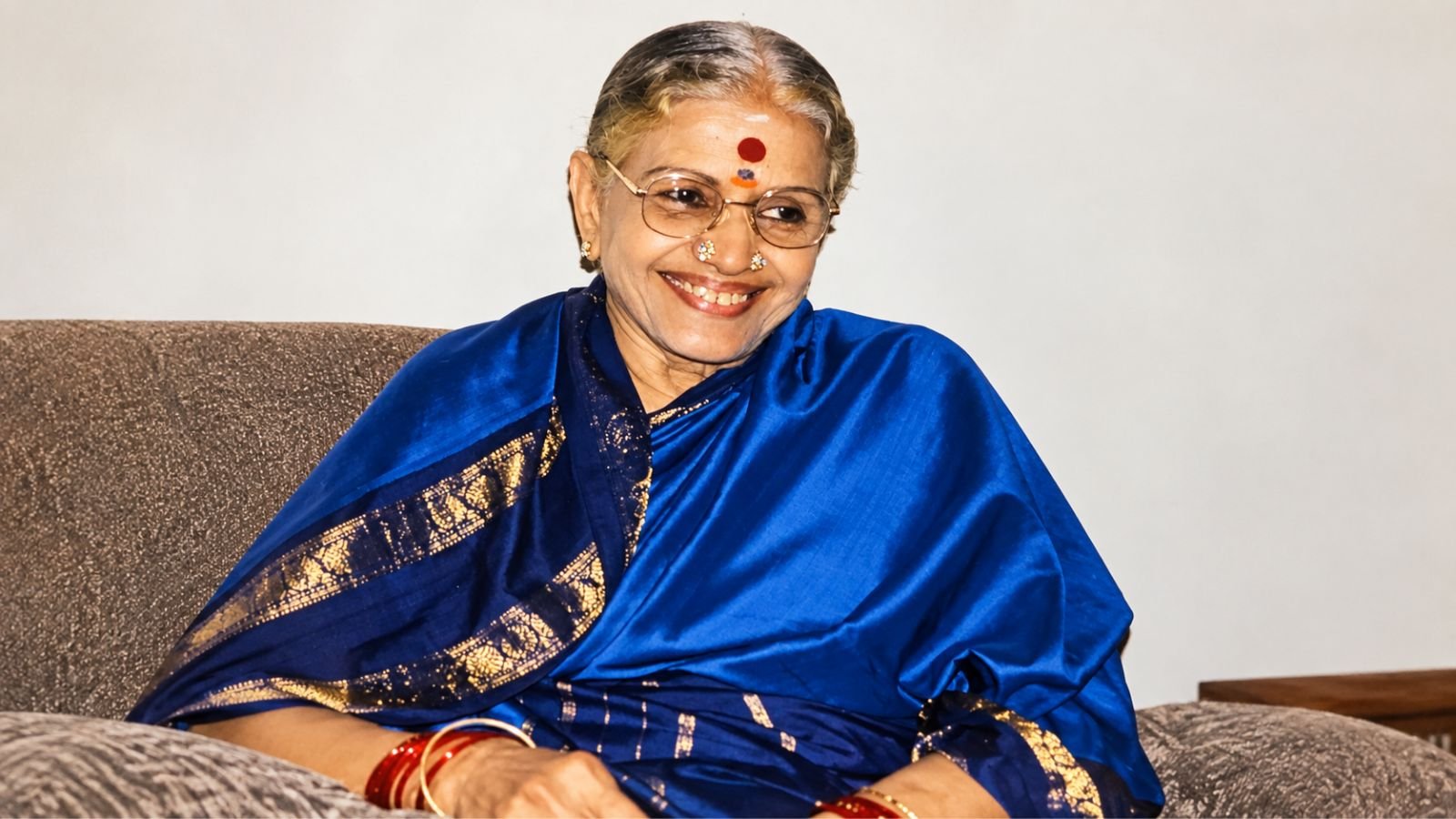
September 16 marks the birth anniversary of M.S. Subbulakshmi (1916), one of India’s most celebrated Carnatic vocalists. Her music carried Carnatic tradition to audiences across India and the world, while her distinctive stage presence became equally memorable. The sari, flowers, jewelry and the serene elegance with which she appeared on stage formed an unmistakable visual identity. Among the colors she wore, one particular shade of blue became so closely associated with her that it came to be known as MS Blue.
The story of MS Blue does not have one universally accepted origin. One account associated with Nalli says that, in 1951, Subbulakshmi brought a blue thread to the store and asked for a sari in the same color. Nalli’s weavers reportedly tested different dyes until they produced a close match. Another tradition, connected with recollections of Subbulakshmi’s family, attributes the creation of her special saris to Muthu Chettiyar, a Kanchipuram weaver.
The color gained wider recognition during the 1960s, when Subbulakshmi’s concerts and public appearances brought increasing attention to her distinctive style. She was frequently seen in silk saris, traditional jewelry and flowers, creating an elegant visual identity that audiences readily associated with her music. Over time, admirers began requesting saris in “MS Blue,” turning a color connected with one performer into a familiar expression in the Indian sari market.
Saris identified with MS Blue draw on the established traditions of Kanchipuram silk weaving. Their bodies are woven with silk yarn, while zari may be used for the borders, pallus and decorative motifs. The appeal of the shade lies not only in the dye but also in the way it interacts with silk. The fabric’s natural luster can make the blue appear deep and almost ink-like in subdued light, then brighter and more radiant when it catches the light.
The exact appearance of MS Blue may vary according to the dye, the silk, the weaving process and the surrounding light. For that reason, descriptions such as “ultramarine,” “deep sea blue” or “inky blue” should be understood as broad visual comparisons, not as a single officially standardized color specification.
Subbulakshmi’s influence gave the shade its lasting cultural identity. Blue saris existed long before her, but her repeated association with this particular family of deep blue tones made the color memorable to generations of listeners, viewers and sari enthusiasts.